
KNEA offers neutral testimony on Senate Bill 302
By Ann Marie Bush
Director of Communications
Timothy R. Graham, Director of Government Relations at the Kansas National Education Association (KNEA), was one of four individuals who provided neutral testimony during a Senate Committee of Education hearing Thursday, Jan. 15, on Senate Bill 302, which prohibits the use of personal electronic communication devices during instructional time.
“In considering SB 302, KNEA begins with an issue that consistently guides its advocacy: local control,” he wrote in his testimony. “In most cases — and KNEA believes in this case, as well — decisions that directly affect students, classrooms and daily school operations are best made by locally elected school boards working in partnership with their communities and educators. This issue is no different. Nevertheless, the Legislature is sending a clear signal that it intends to act in this space.”
Kansas Gov. Laura Kelly also has voiced support for legislation prohibiting the use of personal electronic communication devices during instructional time.
“KNEA believes it is important for educators to be at the table as a resource,” Graham said. “In offering neutral testimony, KNEA is not stepping away from its long-standing support for local control. Rather, KNEA is engaging because these decisions will have real, day-to-day consequences in schools, and there is value in helping ensure the outcomes are thoughtful, workable and grounded in reality.”
In his testimony, Graham outlined several key concerns KNEA has regarding SB 302. These included:
Under the bill, students must qualify for an exception to use a personal device during the school day, which can require students to disclose learning disabilities or medical needs to comply with the law.
For older students who serve as caretakers of younger siblings or respond to family emergencies, limited access to a phone during the day could prohibit important communication.
Enforcement and liability - The bill places enforcement squarely on schools but does not clearly define who is responsible.
The definition of instructional time.
This is an unfunded mandate, which means districts will be required to adopt policies, train staff members, develop storage solutions, enforce compliance and report to the state without additional funding to support these requirements.
Implementation timeline, with required compliance by Sept. 1, 2026.
Others who testified either written or orally included representatives from the Kansas State Department of Education (KSDE), Kansas State Board of Education (State Board) and United School Administrators (USA), as well as a government liaison for Wichita Unified School District 259.
“The Kansas State Department of Education (KSDE) does not take a position on the intent of SB 302 but would like to raise a concern related to the bill’s use of the term ‘instructional time,’ “ KSDE Deputy Commissioner Frank Harwood said. “KSDE is concerned this terminology will cause undue confusion for school districts when considering instructional time that can be counted in fulfilling requirements of the school term.”
Those who testified in support of the bill included a retired law enforcement officer, educator, licensed clinical professional counselor, Wichita USD 259 School Board member, and a parent; and representatives from the Distraction-Free Schools Policy Project Initiative, Kansas Coalition for Distraction Free Schools, Kansas Action for Children, Kids Digital Health Hub/Screen Guardians, Manhattan Institute for Policy Research, Alliance for a Healthy Kansas, and ExcelinEd in Action.
“Kansas children are experiencing unprecedented challenges, and technology is a significant contributing factor,” Adrienne Olejnik, Vice President of Kansas Action for Children, said. “The research and data on the potential harm and impact of digital devices on children’s well-being is compelling and requires us all to consider new ways to help change the trajectory of how technology is impacting kids. Schools that have already implemented bell-to-bell cell phone restrictions are beginning to see positive signs that many of these negative impacts are receding and that children are experiencing improved relationships, mental well-being and educational achievement.”
Those testifying either written or orally in opposition of the bill included a retiree, high school student and parent, as well as representatives from the Kansas Association of School Boards (KASB) and the Kansas PTA.
“As a 4.0 student involved in a variety of extracurriculars, I have always prioritized my learning,” said Kailey Howell, a senior at Spring Hill High School, Spring Hill USD 230. “Phone usage for me was always secondary to my education. While I understand that this is not the case for all students, I am confused as to why I am now having to bear the weight of consequences that were never meant for me. I've learned how to manage my time and put education first despite the distractions, phones included. Why should I now be unfairly stripped of my devices when I never did anything wrong to earn such a consequence?”
Education is what students choose to make of it, Howell continued.
“Students with positive attitudes and a desire to learn, will do so,” she said. “Students who purposely avoid learning at every cost, will not learn. Removing phones doesn't change a student's attitude, it only gives them another avenue to find another distraction.”
The House Committee on Education will have a hearing at 1:30 p.m. Thursday, Jan. 22, on a similar bill, House Bill 2421, which was originally intended as a companion bill to SB 302. It requires school districts to prohibit the use of personal electronic communication devices during school hours. It also prohibits school employees from using social media to directly communicate with students for official school purposes and requires school districts to report student screen time.
Because of the reporting provision, KNEA plans to testify in opposition to HB 2421.
KNEA will continue SB 302 and HB 2421 as they move through the Legislature.
Ann Marie Bush can be reached at ann.bush@knea.org.
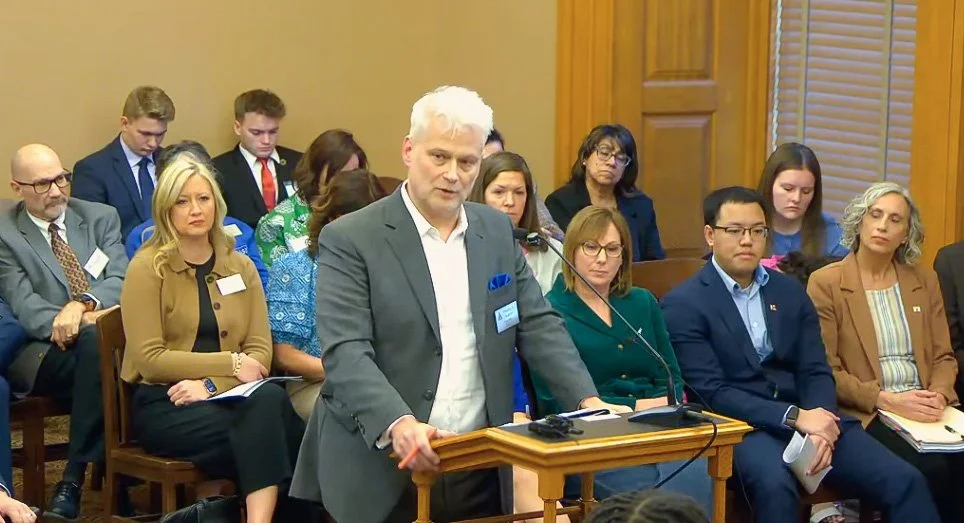
Timothy R. Graham, KNEA Director of Government Relations, testified at the Statehouse on Thursday, Jan. 15, during a Senate Committee on Education hearing regarding Senate Bill 302.