
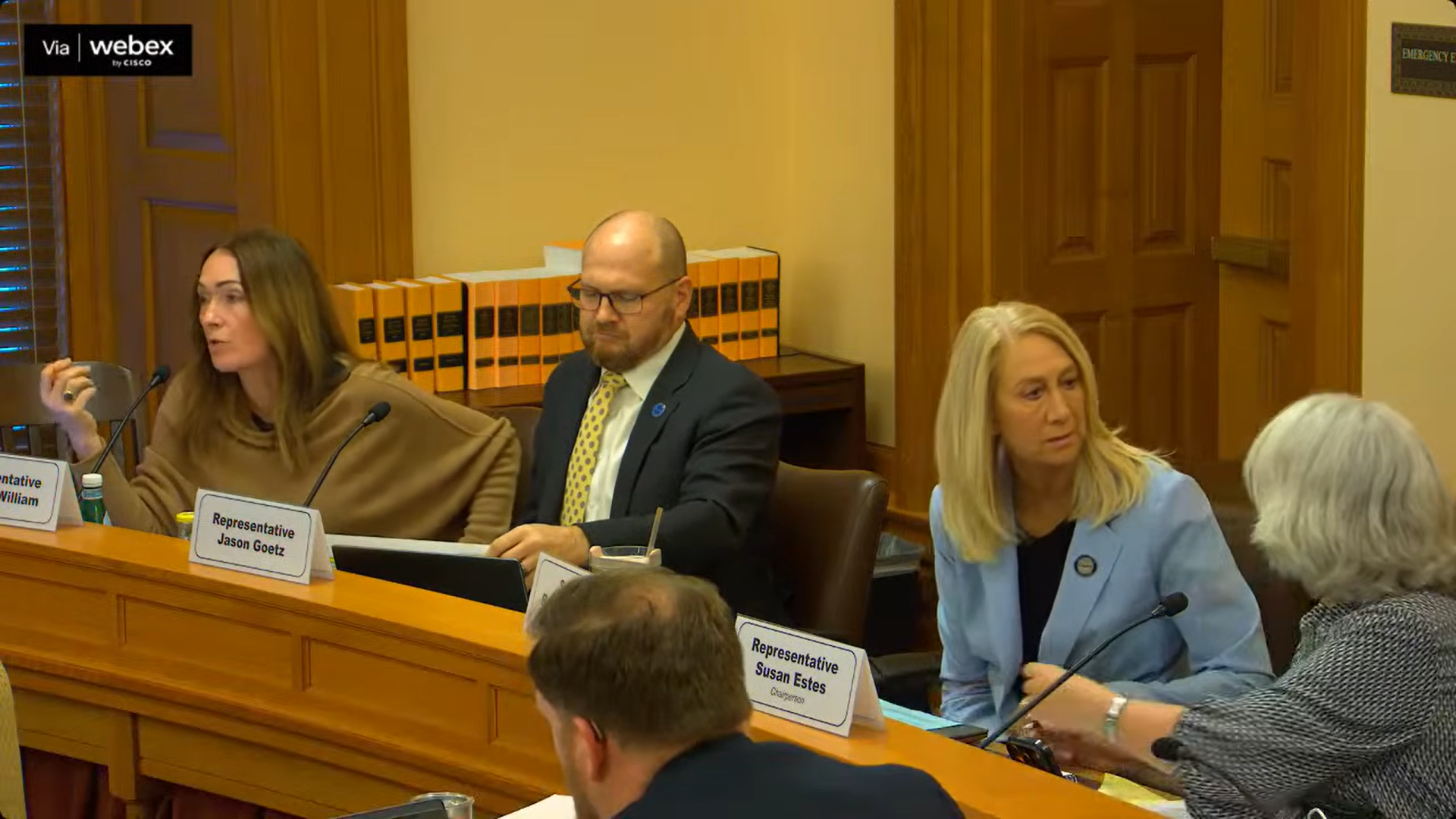
CREDIT: Screen capture from the Kansas Legislature’s YouTube channel.
Rep. Kristey Williams, R-Augusta, far left, speaks during the Education Funding Task Force meeting Nov. 17 at the Statehouse in Topeka. Seated beside her is Rep. Jason Goetz, R-Dodge City. At right, Sen. Renee Erickson, R-Wichita, the task force's vice chair, confers with Rep. Susan Estes, R-Wichita, the chair.
By Timothy R. Graham
Director of Government Relations
The task force writing Kansas' next school finance formula spent Nov.17-18 at the Statehouse in Topeka weighing whether to change how the state pays for special education (SPED) and hearing how the state’s budget outlook has improved.
The current formula expires July 1, 2027, and the Education Funding Task Force’s report is due to the Legislature and the governor by Jan. 11, 2027.
Staff from the Kansas Legislative Research Department walked members through a long list of funding models, each named for a Kansas plant or animal. The task force took no votes on a recommendation. Members also debated whether gifted students should stay in the SPED system, whether new money should be tied to student results, and how the state counts and spends money for at-risk students.
SPED: Reimburse costs or fund by student
Kansas now pays districts for SPED through a reimbursement system. State law sets a target of 92% of what the law calls excess costs.
Frank Harwood, Kansas Deputy Commissioner of Fiscal and Administrative Services at the Kansas State Department of Education (KSDE), said districts spent $1.3 billion on SPED last year from all sources, including state, federal and local money. The Kansas State Board of Education has asked for $113 million a year for the next four years to reach the 92% target by 2031, he said.
Education Task Force members looked at two different options.
One option keeps a reimbursement system and pays more of the bill. A model requested by De Soto Superintendent Cory Gibson, a task force member, would have the state cover all SPED costs not paid by federal aid or Medicaid. Staff estimated it would raise SPED state aid by about $350 million. Gibson said he wanted to show "the true cost for special education."
The other option replaces reimbursement with a weighting tied to each student. One model sorts students into three tiers by type of disability. Another model sets funding by the share of a district's students in SPED. A third model, requested by Rep. Jason Goetz, R-Dodge City, uses four levels based on the hours of service a student gets each week. Staff estimated it would add $103.4 million.
The hours-based model drew questions. Gibson asked whether teams that write a student's Individualized Education Program (IEP) might round hours up to reach a higher funding level.
Rep. Megan Steele, R-Manhattan, said she liked the idea of a student-based model but not the hours.
"I worry about using time because there's going to be bad actors, unfortunately," she said.
Goetz said he sits in those meetings for his own son.
"I think we have good people that are making the best decisions they can," he said.
Melissa Rooker, executive director of the Kansas Children's Cabinet and Trust Fund, pointed to districts that already move millions of dollars from their general funds to cover SPED. Some of those districts would get less under the hours-based model, she said.
Harwood said timing is also a problem. Many districts deliver SPED through cooperatives and interlocals, and every one of those agreements would have to be rewritten under a student-based model. He said it would be "nearly impossible" to start one in fiscal year 2028.
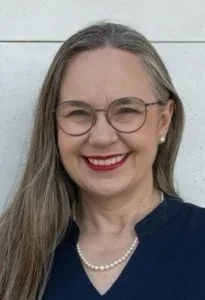
Photo courtesy of Kansas Legislature
Rep. Nikki McDonald,
D-Olathe
Rep. Nikki McDonald, D-Olathe, said the cost does not go away if the state pays less.
"We're already on the hook for that money," she said. "That money is being spent already on special ed kids."
The sharpest exchange came Tuesday afternoon, in a room full of teachers, retired teachers, school administrators and representatives of education advocacy groups.
Rep. Kristey Williams, R-Augusta, said SPED cash balances in districts have grown by $39 million in three years and that Kansas identifies more students for SPED than the national average.
"Some of these models are incentivizing higher identification," she said.
Lindsey Graf, KSDE’s director of special education, said the cause runs the other way.
"We don't have the resources in the general education because we're taking those resources to fund special education," she said.
Williams pressed the point.
"What I hear you say is that we're purposefully overidentifying students in order to compensate for the lack of funding,” Williams said.
The remark drew audible groans from an audience that had sat quietly through most of two days.
"I just did not say anything about we were purposefully misidentifying," Graf said.
She said students who fall behind without general education support can end up meeting the criteria for SPED.
Sen. Scott Hill, R-Abilene, sided with Williams. He called the discussion "extremely troubling" and questioned the idea that a lack of general education money is pushing students into SPED.
On the cash balances, Jefferson West Superintendent Brad Neuenswander, a task force member, said they reflect when money arrives. SPED state aid does not reach districts until October or November, he said, so districts have to carry money over on July 1.
Staff will bring the SPED models back in December using 2025-2026 data. Gibson asked that they be run at the same total dollar amount so members can compare them side by side.
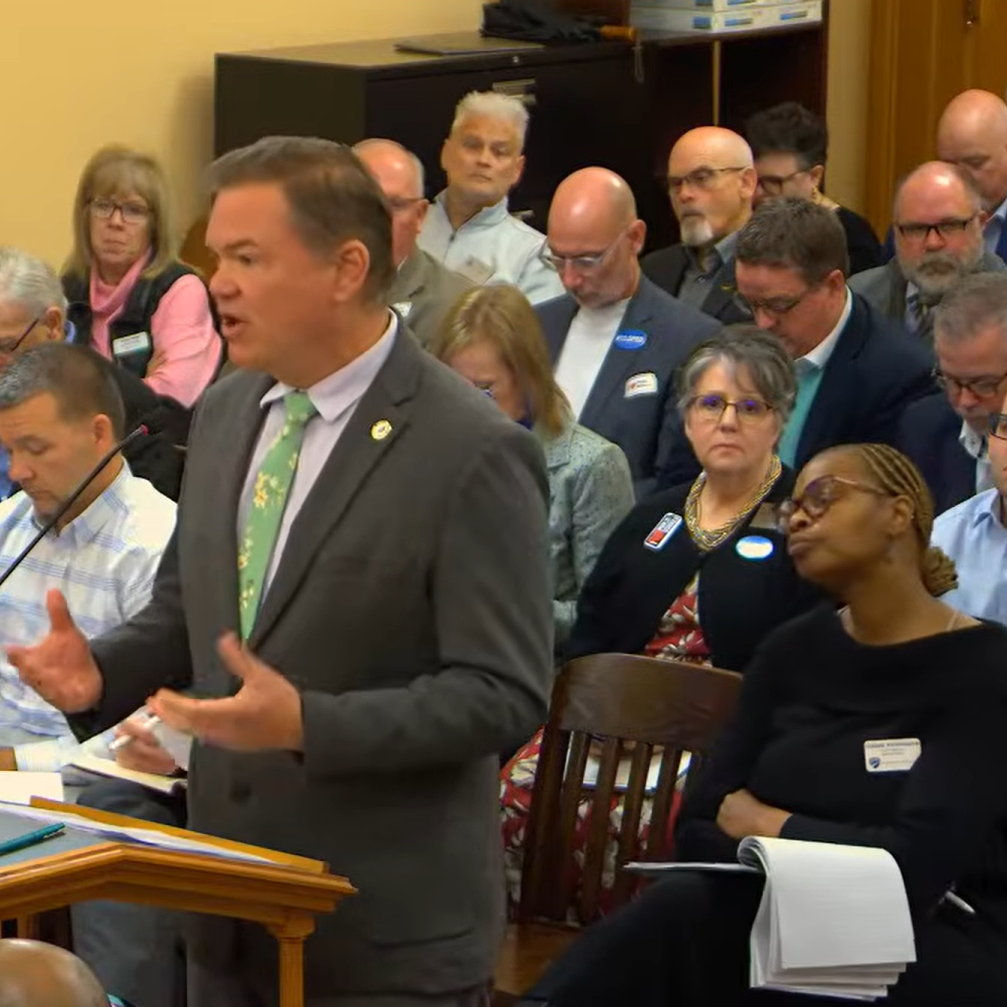
CREDIT: Screen capture from the Kansas Legislature’s YouTube channel.
Dylan Dear, assistant director for fiscal affairs at the Kansas Legislative Research Department, gives an unscheduled update on the state's improved revenue estimates Nov. 17 to the Education Funding Task Force in a full hearing room at the Statehouse. KNEA member Leanne Richardson, bottom right, and KNEA Director of Government Relations Timothy R. Graham, top center, look on. Richardson was among several KNEA members who spent both days at the Statehouse watching the meetings.
A better budget outlook, and a caution
Dylan Dear, assistant director for fiscal affairs at the research department, told members Tuesday morning that the new revenue estimate for fiscal year 2027 is up about $426 million, or 4.2%, from the estimate six months ago.
"This profile is going to look a lot better" than the one lawmakers saw at the end of the session, he said.
The state is still on track to spend about $50 million more than it takes in next year, he said, down from about $400 million.
Dear also urged caution. Small increases in spending or small cuts in revenue, he said, "can have outsized consequences in the long term."
That afternoon, state Budget Director Adam Proffitt was asked what Gibson's full-reimbursement model would do to the state's bottom line. The whole model carries a price of $508.1 million. Proffitt said it would put the state back in the red in fiscal year 2028 and back in the black the next year, if revenues hold and nothing else changes.
He added that the projection assumes lawmakers "take the next five years off and don't do anything else."
"I don't think they're going to do that,” Proffitt added.
Steele objected to the largest model, which totaled $1.1 billion.
"I am struggling to understand truly where there is a billion dollars in the budget," she said.
Neuenswander said Wednesday that the model was his and that it combined five separate ideas into one run. Doing all five at once, he said, was "not the intention."
Should gifted stay in SPED?
Sen. Renee Erickson, R-Wichita, the task force's vice chair, asked staff what it would look like to take gifted students out of SPED and fund them with a separate weighting.
Harwood said federal law does not require gifted services. Kansas law does. Staff said 10,431 gifted students were served in 2025-2026. Harwood put gifted spending at about $9.9 million in a recent year.
In a show of hands Wednesday, voting members agreed to keep gifted funding at least where it is now. They did not settle whether gifted students should keep an IEP.
McDonald said an IEP gives parents and teachers a clear goal and a way to measure it.
"If you're not measuring a goal, it's not going to be delivered," she said.
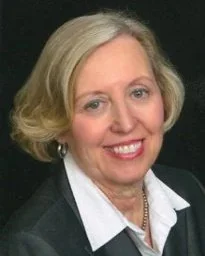
Photo Courtesty of Kansas Legislature
Sen. Pat Pettey,
D-Kansas City
Erickson said a separate weighting could give districts more flexibility.
Steele said gifted services tie up "a lot of paperwork."
Sen. Pat Pettey, D-Kansas City, said families have long expected gifted services in Kansas schools. Rooker noted that state law requires a parent's consent for major changes to a student's IEP.
Accountability and a K-3 reading weighting
Tuesday opened with an hour-long staff presentation on school accountability systems in Massachusetts, New Jersey, South Carolina and Wyoming.
Williams said Massachusetts and New Jersey outscore Kansas on national tests. It would be worth seeing, she said, "if high expectations really do help drive success, which I would argue they do."
McDonald said talk of tying money to performance makes her "bristle a little bit."
"Base funding should reflect the cost of actually educating the students,” she said.
Asked whether accountability in those states is tied to their funding formulas, senior research analyst Nicole Bergman said staff did not find "a very clear and direct tie to funding."
The idea showed up in the models as a new weighting for students in kindergarten through third grade. Goetz requested three versions. The largest would add about $70.6 million for early reading. One version paid for the weighting by cutting the at-risk weighting for all grades. Goetz said he ran that version to show "how unfair it can be in different districts."
Senior fiscal analyst Jennifer Light said the models send the money out by the number of K-3 students, with no conditions. Any conditions would be a policy choice for lawmakers, she said.
Williams said the money should come with them.
"When we put in five-plus billion, we are asking for our kids to be able to read," she said. "I think it should be connected to outcomes."
Steele agreed.
"I do think that policy changes need to hold schools accountable," she said.
McDonald said she worries the dollars would depend on test results.
"I have a lot of concerns when we tie dollars in such a huge way to achievement, because I think it unnaturally punishes the poor schools, the bigger schools," she said.
Goetz said he could support a pairing: Freedom for districts to follow agreed reading practices, the money to do it, and tracking to make sure the dollars stay there. He said that does not have to mean taking money away.
At-risk funding: Who qualifies? How is the money spent?
Erickson put at-risk funding at more than half a billion dollars a year. The amount is based on how many students get free lunch.
Several members said free lunch is the wrong measure.
"Free lunch does not determine that a kid is at risk," Neuenswander said.
Hill put it this way: "I judge the fatness of a cow by her back fat, not how many flies she's got on her."
Two models offered replacements. One counts only students who qualify for free lunch automatically through programs, such as food assistance or Medicaid. The other uses state test results. It would fund districts by the share of students scoring in the two lowest levels and add a "success" weighting for students in the two highest.
Staff estimated the test-based model would cut state foundation aid by 6.3% in Turner and 6.1% in Kansas City, Kansas, the largest losses in the state.
Pettey said the districts that lose the most are low-income districts with many minority students.
McDonald said she opposed the model as written.
"We end up being really punitive to the most needy students that we have," she said.
Task force members also questioned how at-risk money is spent. Steele said "three different post audits" found the money "is not being used effectively."
Erickson said one audit recommended that the Legislature define what the law means by services "above and beyond" regular instruction.
"To me, there is no student more at risk than a student who can't read by the end of third grade," Erickson said.
She said money for a reading weighting should come from at-risk funds.
Harwood said districts are using at-risk money to improve results.
"Is it to the level that we all like? It's not," he said.
The task force has not discussed what results would look like without it, Harwood said.
Erickson answered that point Wednesday.
" ‘Well, it could be worse,' is not a data-based proof to me that we should be adding more money to at-risk funding," she said.
Other ideas on the table
Pre-K: One model would fund all pre-K students, not only those who are at risk, at an estimated $105.2 million. Pettey supported the idea. Steele opposed "bringing in a whole new group of students."
Virtual schools: One model would tie per-student virtual funding, now a flat $5,600, to base aid so it rises with inflation.
Bilingual: One model would pay a higher weighting for a student's first three years in the country and a lower one after that. Goetz said Dodge City would lose more than $1 million.
Property taxes: Several models would raise the state's share of local option budgets. That would lower local property taxes without giving districts more money to spend, Neuenswander said.
Enrollment counts: One model would let districts use a three-year average. Steele and Erickson opposed it, saying a student who moves could be counted by more than one district.
What's next
The task force is scheduled to meet again Dec. 10-11. Staff will return with updated SPED models, more complete at-risk data and new runs that task force members requested. Members also asked staff to show what it would take to keep districts from losing money under each change.
Lawmakers will take up the formula when the 2027 session opens in January.
Resources
Education Funding Task Force page, with agendas and documents
Fall 2026 consensus revenue estimate memo and state general fund profile
Elsewhere in the news
Morgan Chilson, Kansas Reflector: Task force dives into possible changes to Kansas school funding as current formula is set to expire, Nov. 19. Covers both days, including Kansas Association of School Boards lobbyist Leah Fliter on the winners-and-losers effect of changing weightings, and an exchange between McDonald and Erickson over whether a new formula should leave any district with less money.
KSHB 41 News, Kansas City: 'We want what's best for all school districts:’ Kansas Education Funding Task Force weighs new finance formula, Nov. 19. A reporter in the room, with Johnson County task force members and superintendents from De Soto, Olathe, Shawnee Mission and Blue Valley.
Timothy R. Graham is KNEA's Director of Government Relations and Legislative Affairs. He can be reached at timothy.graham@knea.org.
For ongoing coverage of legislative activity affecting public education in Kansas, visit Under The Dome at ksutd.org.