
Week 10 Wrap-Up: Legislature meets Second Chamber deadline
By Timothy R. Graham
Director of Government Relations
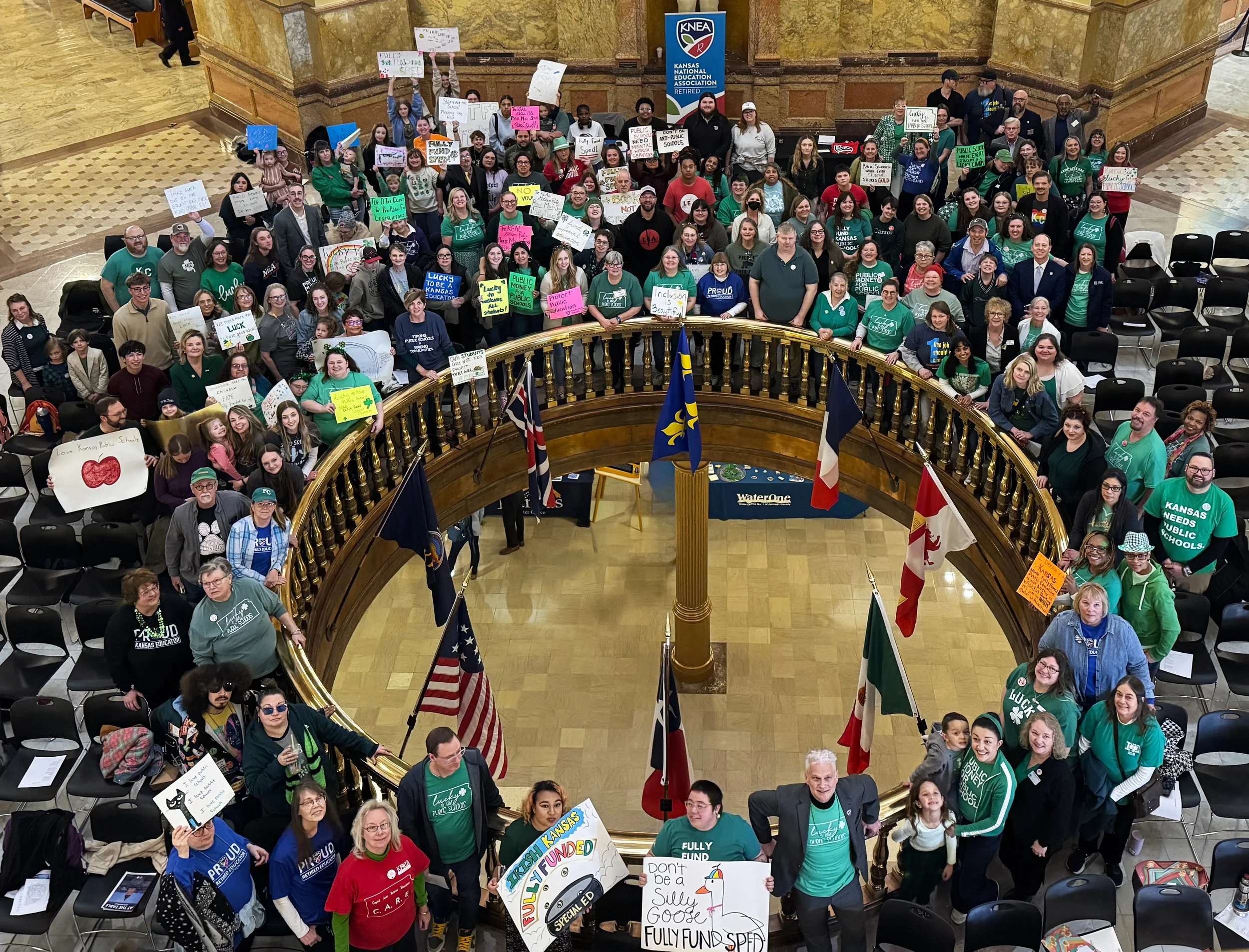
Kansas educators, students and supporters of public education posed for a photograph at the Lucky to Have Kansas Public Schools Rally on March 17 at the Statehouse.
Legislative activity accelerated during the tenth week as lawmakers worked to meet the Second Chamber Consideration deadline, which was on Friday, March 20.
Floor debate and final action increased in both chambers, while committee activity narrowed as standing committees wrapped up most of their work for the session.
Several education-related measures advanced through final stages of the process, including conference committee reports and substitute bills moving to final action. Attention also began shifting toward conference committees and final negotiations as the Legislature moves into the closing phase of the regular session.
Gov. Laura Kelly on Thursday, March 19, signed a bipartisan bill banning the use of cell phones and personal electronic devices during the school day.
Senate Substitute for Substitute for House Bill 2299 requires Kansas public schools and accredited private schools to prohibit the use of personal electronic devices during the school day on school premises. These devices include, but are not limited to, cell phones, tablets, computers, watches, wireless headphones or earbuds, text messaging devices and personal digital assistants. Students’ personal devices must be turned off and securely stored during the school day.
Member engagement remained visible at the Statehouse, highlighted by a large turnout of educators, students and public education supporters participating in advocacy events and the Lucky to Have Kansas Public Schools Rally at the Capitol.
Committee action and bill hearings
View all KNEA testimony submitted this session here.
SB 381: Requiring instruction on communist and socialist regimes and requiring students to pass a civics exam to graduate.
Hearing: March 16
Room: 218-N
Committee: House Committee on Education
KNEA position: Oppose
The House Committee on Education held a hearing on SB 381 on Monday, March 16. The bill would require additional curriculum related to political ideologies and establish a graduation requirement tied to a civics examination.
Chamber floor action
Floor activity increased this week as the Kansas Legislature moved closer to the Second Chamber Consideration deadline. Both chambers acted on a mix of policy and conference committee reports, with several education-related measures advancing.
H Sub for SB 366: Prohibiting use of a mobile telephone while operating a motor vehicle in school or construction zones and establishing related penalties.
House vote: 116-7
Senate vote: 31-9
KNEA position: Support
Next step: Sent to governor
The House advanced the substitute bill through Committee of the Whole on Monday, March 16, before passing it on final action Tuesday, March 17. The Senate later concurred Thursday, March 19.
HB 2468: Expanding participation in a federal tax credit program for contributions to scholarship granting organizations and increasing the program cap.
Senate vote: 27-12
KNEA position: Oppose
Next step: Sent to governor
The Senate adopted the conference committee report Monday, March 16, advancing the bill to final enrollment.
SB 517: Expanding literacy reporting requirements and establishing additional coordination between the Kansas State Board of Education, Board of Regents and school districts.
Senate vote: 39-1
KNEA position: Support
Next step: Sent to House for consideration
The Senate passed the bill as amended Thursday, March 19.
HB 2320: Addressing school enrollment and records transfer for children in the custody of the secretary for children and families.
Senate vote: 40-0
KNEA position: Support
Next step: Sent to governor
The Senate approved the measure on final action Thursday, March 19.
S Sub for HB 2402: Requiring eligible boards of education to consider participation in the community eligibility provision (CEP) and directing the State Department of Education to assist districts.
Senate vote: 38-2
KNEA position: Oppose
Next step: Sent to governor
The Senate advanced the substitute bill to final action Thursday, March 19.
Members at the Statehouse
Nearly 200 educators, students and public education supporters gathered at the Statehouse on Tuesday, March 17, for the Lucky to Have Kansas Public Schools Rally, along with a series of coordinated advocacy events throughout the day.
Participants attended the Emerald Educator Breakfast, took part in a legislative luncheon and engaged directly with legislators inside the Capitol. Attendees also participated in self-guided tours, created advocacy materials and took part in organized activities before convening in the second-floor rotunda for the rally.
The event reflected continued member engagement at the Statehouse as part of broader advocacy efforts during the legislative session, with participation from educators, students and community members across Kansas.
In the news
WIBW Channel 13 reported on the rally in a segment titled Kansas educators rally at Statehouse for fully funded public schools, which included remarks from KNEA President Sherri Schwanz.
KSNT Channel 27 covered the event in a segment titled Kansas NEA hosts second annual Lucky to Have Kansas Public Schools Rally at the Capitol on Tuesday,” featuring interviews with Timothy R. Graham and Olathe NEA President Angie Powers.
The Kansas Reflector reported on legislation that would require high school students to pass a U.S. citizenship test as a graduation requirement.
Looking ahead
The Legislature moves past the March 20 Second Chamber Consideration deadline, with remaining work expected to focus on conference committees and floor debate on conference committee reports. Standing committees have largely concluded their work for the 2026 session.
All eyes are on the state budget as conferees hold ongoing meetings to finalize spending decisions. Attention is also focused on HB 2468, which expands the state’s Tax Credit for Low Income Students Scholarship Program by increasing the annual cap from $10 million to $15 million and authorizes Kansas to opt into a new federal tax credit program for contributions to scholarship granting organizations. The bill has been sent to the governor for action. Several other measures continue to move through the final stages of the legislative process.
Key deadlines ahead include First Adjournment on March 27. After that date, only vetoes, omnibus appropriations and budget reconciliation measures may be considered. Veto Session is anticipated to begin April 9.
Additional details will be included in the Weekly Look Ahead to be published Monday, March 23.
For ongoing coverage of legislative activity affecting public education, visit Under The Dome at www.ksutd.org. The site features bill tracking, updates and additional resources to help educators stay informed and engaged throughout the 2026 legislative session.
Timothy R. Graham can be reached by email at timothy.graham@knea.org.