
Bill would require parental consent prior to providing certain school-based mental health services
By Ann Marie Bush
KNEA Communications Director
A bill requiring school districts to obtain parental consent prior to providing certain school-based mental health services to a student is written too broadly and could delay supports students need to stay engaged in learning, opponents told lawmakers Thursday.
House Bill 2420 uses “an overly broad definition of school-based mental health services,” said Timothy R. Graham, Director of Government Relations for the Kansas National Education Association (KNEA), during a House Committee on Education hearing Thursday, Jan. 22.
Under that definition, Graham testified, school staff could be required to obtain written parental consent before providing Tier 2 and Tier 3 supports that are used daily in classrooms.
“Educators across Kansas have raised concerns that simple, short interventions - such as pulling a student aside briefly to de-escalate, offering a quiet reset, or using a focused one-on-one activity - could trigger requirements for verbal notification and written parental consent,” Graham said. “These are not formal mental health services, but common classroom management tools, and requiring advance notification and dual consent for these moment-to-moment practices is not workable.”
Sixty-three opponents submitted written testimony, while Graham was among six individuals who testified in person against the bill. Three proponents testified in person, while seven submitted written testimony. There was one person who offered neutral written testimony.
Rep. Dr. Megan Steele, the bill’s sponsor, was the first to testify in support of HB 2420.
“It reinforces a fundamental principle that parents have the primary responsibility and authority over decisions that affect their child’s education, health and well-being,” Steele said.
She noted that Kansas law already requires parental consent for special education evaluations and services, medical care provided at school, and participation in certain assessments and surveys.
“Mental health services can be just as significant, and often more sensitive, than these other interventions,” Steele said.
She emphasized that the bill does not prohibit teachers from checking in with students or offering general supports.
“This legislation does not prohibit teachers from asking how a child is doing … Those are all Tier 1 supports that every student gets in our school system,” Steele said. “This bill also supports those students that are potentially at risk of self- harm or harm to others … Finally, the accountability provisions in this bill are not about punishment. They exist to protect families from being excluded from significant decisions that affect their child’s life.”
Committee member Rep. Jason Goetz referenced Steele’s background as a school nurse and asked what problem the bill is intended to solve.
Steele said she has heard from constituents who discovered their children were being pulled from class by counselors or social workers to discuss depression, anxiety or gender dysphoria without parental knowledge.
“When instructional time is interrupted for services that go beyond general support and move into mental health intervention, parents should be informed and involved,” Steel wrote in testimony. “These decisions affect not only a child’s emotional well-being but also their academic experience.”
“These are not formal mental health services, but common classroom management tools, and requiring advance notification and dual consent for these moment-to-moment practices is not workable.”
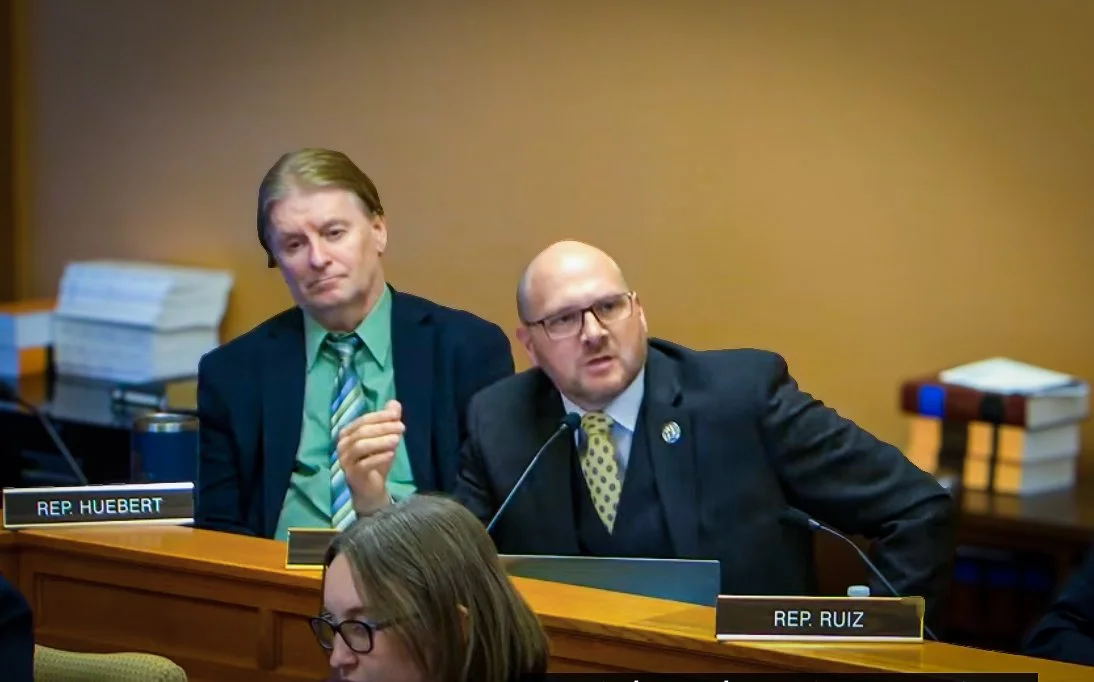
Rep. Jason Goetz asked questions about House Bill 2420 on Thursday, Jan. 22, during a House Committee on Education hearing.
Graham warned the bill would undermine classroom safety and instruction.
“House Bill 2420 would make classrooms less safe by limiting educators’ ability to act in the moment,” he said.
The bill also imposes a $5,000 civil penalty per violation on school districts. Graham called the penalty heavy, arbitrary and disconnected from classroom realities, saying it created fear rather than clarity for educators exercising professional judgement.
“We are willing to engage in serious, good-faith discussions on this issue,” Graham said. “But if this bill is going to move forward, the definition of ‘school-based mental health services’ must be significantly tightened so routine classroom management and de-escalation practices are not swept in.”
Ann Marie Bush can be reached by email at ann.bush@knea.org.