
KNEA offers testimony in opposition of voucher-adjacent bill
By Ann Marie Bush
Director of Communications
Public funds must remain dedicated to public schools – and they shouldn’t support private education without equivalent public accountability.
That message was echoed repeatedly during testimony opposing House Bill 2468 at a hearing Wednesday, Jan. 21, before the Kansas House Committee on Education.
Twenty-five opponents, including the Kansas National Education Association (KNEA), one neutral conferee, and 14 proponents testified on HB 2468. The voucher-adjacent proposal would allow Kansas to participate in a federal tax credit program for contributions to scholarship-granting organizations (SGOs) and increase the tax credit limit under the Low-Income Student Scholarship Program.
While described as a tax credit, the program functions similarly to a voucher by using public tax policy to subsidize private school tuition. Timothy R. Graham, KNEA’s Director of Government Relations, provided oral testimony in opposition of the bill.
“Programs that use public tax policy to subsidize private education - whether through direct appropriations, state tax credits or federal tax credits - divert public resources away from the public education system that is required to serve all students,” Graham said in his testimony. “Public schools must educate every child, including students with disabilities, English language learners and economically disadvantaged students, and must do so under clear accountability, transparency and nondiscrimination standards.”
Graham also noted that opting Kansas into the federal program would require the state to administer a framework largely defined at the federal level. Once opted in, Kansas would have limited ability to adjust the program or respond if federal rules or program impacts conflict with state education priorities.
Oversight is another concern. This structure relies heavily on private SGOs, with accountability split between state agencies and yet-to-be-released federal guidance. Graham said this raises questions about transparency, enforcement, and whether meaningful oversight would exist for programs supported through public tax policy.
Jim Karleskint, Director of Legislative Services for United School Administrators (USA), shared similar concerns. Although he taught in private schools, he testified that USA opposes the use of public funds for private schooling.
“It is a concern of ours – and mine – that this does not provide equitable access for students with disabilities, English language learners or at-risk populations,” Karleskint said.
Proponents of the bill offered a different perspective. Several private school administrators testified in favor, along with Scarlett Acosta, a Bishop Ward High School student who attends her school through a scholarship.
“Tax credit scholarships play a vital part in the lives of many students, including mine,” Acosta testified. “My family does not have excess money. My parents came here looking for the American dream. They wanted a better future for their children and sacrificed everything for us. To be able to attend a private Catholic school is a privilege in my eyes. They have provided me with more opportunities that I could ever dream of and an education beyond words.”
Andrea Hillebert, a private school teacher and administrator for 33 years, said expanding tax credits would support families seeking educational options.
“I believe the time has come to increase the cap for tax credits that support low-income students,” Hillebert said. “In education we are called – we have always been called - to be bold and do what is best for children.”
KNEA will continue to follow HB 2468 and related legislation as the 2026 session continues. For updates, visit http://www.ksutd.org/.
Ann Marie Bush can be reached by email at ann.bush@knea.org.
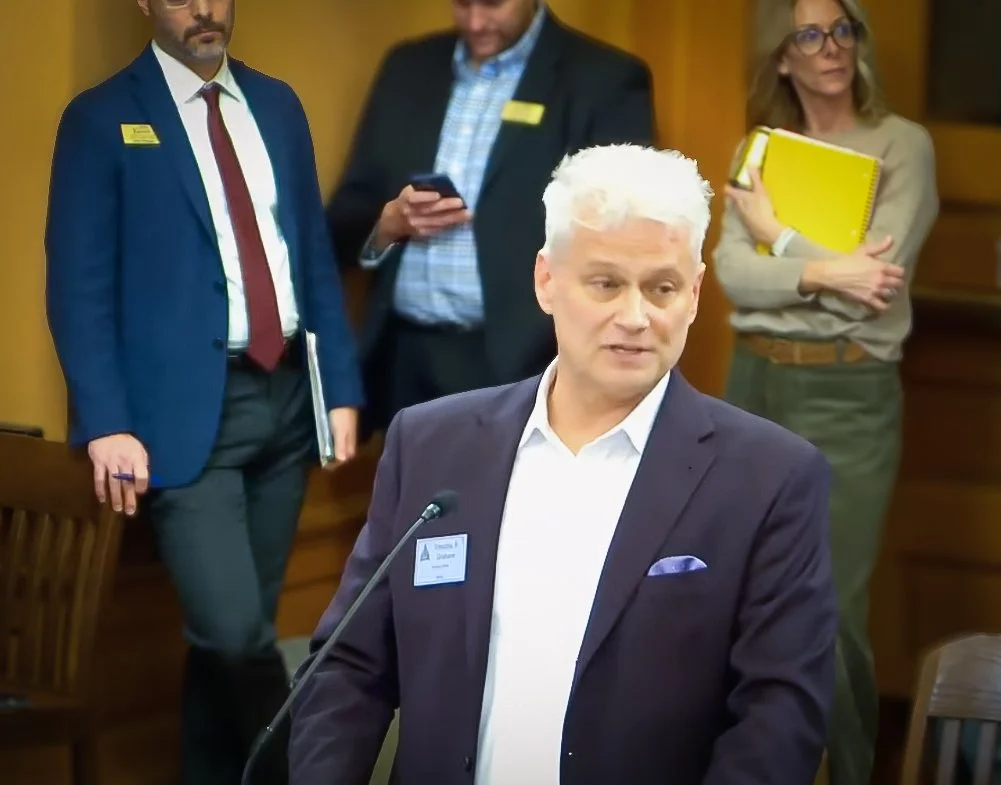
Timothy R. Graham, KNEA’s Director of Government Relations, testified Wednesday, Jan. 21, in opposition of House Bill 2468.