
Graham’s Grumblings: From desert nights to Statehouse fights

By Timothy R. Graham
Director of Government Relations
This past week, I attended the NEA-Retired Conference in Chandler, Arizona, where retired educators from across the country gathered for several days of training and seminars focused on how they can remain active in their union roles and continue advocating for public education.
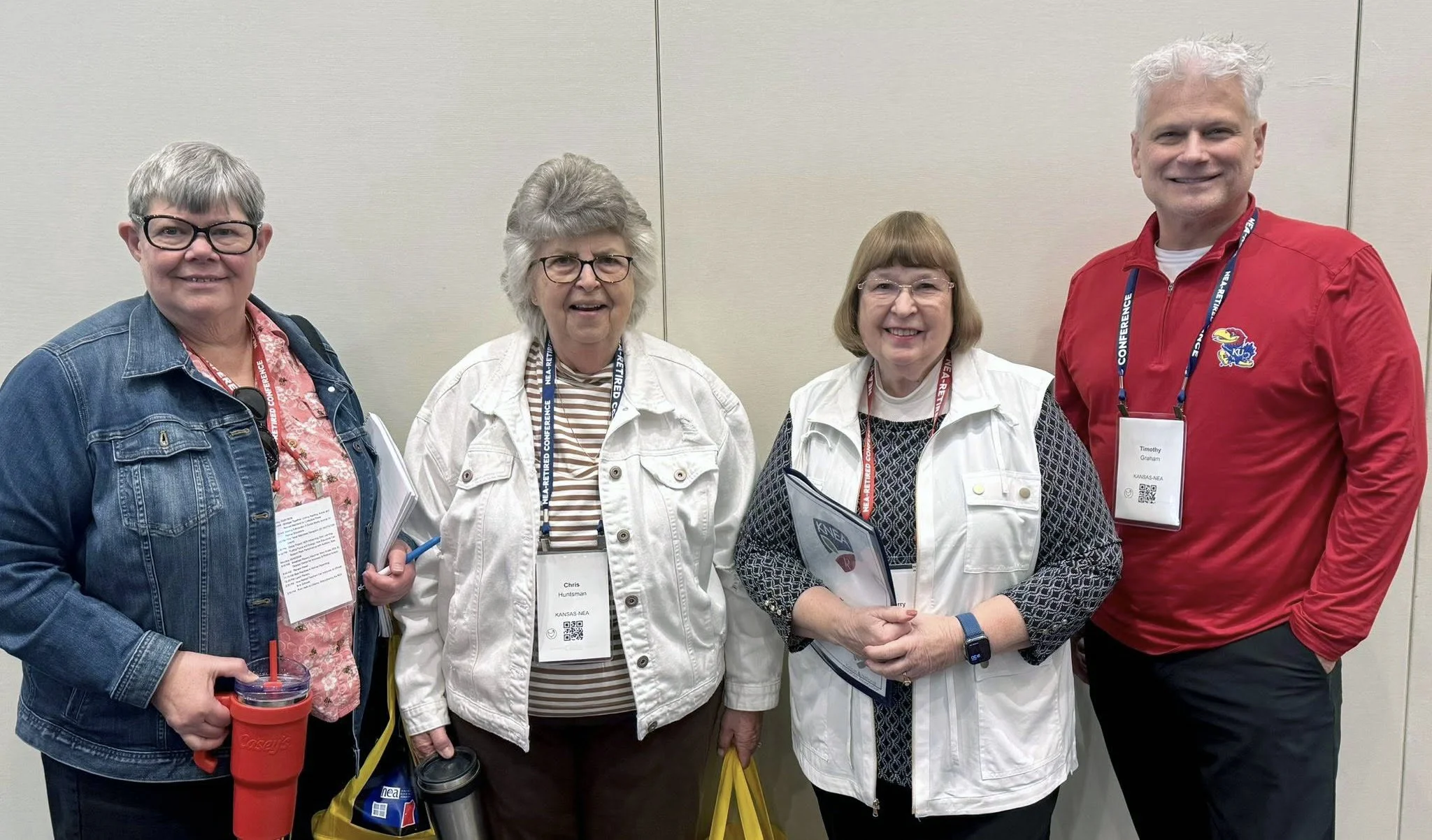
From left: Mary Masters, KNEA-Retired Secretary-Treasurer, Chris Huntsman, KNEA-R KPERS representative, Sherry Turnbull, KNEA-Retired President, and Timothy R. Graham, KNEA Director of Government Relations attended the NEA-Retired Conference in Phoenix, Arizona.
I’ll admit I’m not always thrilled about giving up a weekend for conferences anymore, but the trip turned out to be well worth it - thanks in no small part to the company of Kansas retired members Sherry Turnbull, Mary Masters and Chris Huntsman, and several thoughtful sessions along the way.
As the conference wrapped up Tuesday afternoon, my focus quickly shifted back to Kansas. I spent the trip home following the Kansas Senate’s debate on the state budget - starting while I waited for my Uber to the airport, continuing through the flight, and still listening as I made the drive back to Lawrence from MCI.
The transition from sunny 80-degree Arizona to rainy 30-degree Kansas - and from conference optimism to Statehouse budget debates - felt less like a gentle return home and more like having a bucket of ice water dumped over my head.
To be clear, I’m exaggerating a little for dramatic effect - I’m genuinely glad to be home.
But the shift from conference optimism to the hard realities of education advocacy at the Kansas Statehouse kind of stunk.
The budget debate itself was disappointing for reasons you can read about here:
https://www.ksutd.org/all-news/kansas-senate-narrowly-passes-budget-cell-phone-bill-takes-another-turn
And if that bucket of water really had been dumped over my head, it likely would have turned to steam the moment I heard we’d be having yet another debate about a statewide cell phone ban in schools.
Yes, I’m still obsessed.
As I settled back into my everyday routine this week, I watched the debate unfold in the Kansas Senate on Thursday, March 5. I watched the people and the process that I know so well - and, at times, the circus that inevitably comes with it.
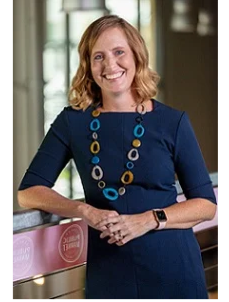
Sen. Dinah Sykes
As the debate came to a close, Sen. Dinah Sykes, D-Lenexa, rose to explain her vote.
Make no mistake - Sen. Dinah Sykes is a longtime ally of public education and KNEA. Let me repeat that: Sen. Dinah Sykes is a longtime ally of public education and KNEA. And as she rose to speak, the weight of the moment was clear as her voice cracked with emotion on the Senate floor.
She reminded her colleagues that she had supported the idea behind the bill from the beginning, pointing to the very real mental health challenges facing students.
“Mr. Chair, this bill has been a whole process, and actually, I have been one who has supported it from the start,” Sykes said. “Kids are suffering - anxiety and mental health issues are real, and this is a step in the right direction.”
But she also acknowledged the difficult balancing act the issue had created.
“I struggled with this for two years trying to find the right path … I went against a lot of people who think I’m taking away local control,” she said.
In the end, she conceded the bill was imperfect but expressed hope that the Legislature’s action would ultimately benefit Kansas students.
“This is not perfect… but I think we will look back and realize this was the right thing for our kids,” Sykes said.
This is also what leadership looks like.
Sykes wasn’t looking for a viral clip. She wasn’t practicing hashtag legislating. She was weighing competing values and putting what she believes is the mental health of Kansas students above the easy dopamine hits that come from cheap political applause.
And let me be clear about something else: Reasonable people can disagree about this bill. The arguments on both sides are serious and sincere. But for the sake of this conversation, let’s set aside the debates over unfunded mandates, parental rights, and classroom distraction - issues that, along with many others, have been part of this discussion all session.
Instead, let’s talk about local control, because that has become the central argument against statewide action.
Local control matters. It’s one of the guiding principles of public education in Kansas.
But history also teaches us something important - local control has never been absolute.
I’m glad Abraham Lincoln didn’t decide that the protection of slavery should be left to local control when southern states claimed the right to preserve it.
I’m glad Dwight Eisenhower didn’t defer to local control in 1957 when he sent federal troops to enforce the integration of Little Rock Central High School.
I’m glad the federal government didn’t look the other way in 1960 when 6-year-old Ruby Bridges had to be escorted to school by U.S. marshals just to attend class in New Orleans.
And I’m glad Lyndon Johnson didn’t step aside in the name of local control when Congress passed the Civil Rights Act of 1964 and the Voting Rights Act of 1965.
Sometimes leadership requires stepping beyond local control to confront a larger public problem.
Now, before any of the live-to-be-offended keyboard warriors fire up their social media accounts, let me be clear about something. I’m not making any moral equivalency between the civil rights struggles of our nation’s past and a debate over cell phones in Kansas schools.
What I’m pointing out is something much simpler - this argument about local control is not new.
And in many cases, it’s a damn good argument.
Local control absolutely has a place in our public discourse. In fact, former U.S. House Speaker Tip O’Neill famously reminded us that “all politics is local.”
He was right.
Communities want a voice in the decisions that affect their schools, their neighborhoods and their children.
But history also reminds us that local control has always existed within a larger system of law and public responsibility.
So, you may say the examples I listed above are apples-to-oranges comparisons. You may say I’m conflating states’ rights and local control.
Maybe.
So, let’s bring this home to Kansas education policy.
Ninety-nine percent of the time, Kansas should defer to local control and local school boards on district policies. I believe that. We have fought for that principle, and we will continue to fight that battle when appropriate.
But let’s not pretend anybody in this debate is a pure absolutist.
Are we really prepared to say every district should make up its own vaccine policy from scratch?
Are we comfortable with every district setting its own rules about guns in schools?
And don’t we want to keep ICE (Immigration and Customs Enforcement) out of our schools with statewide legislation?
And do you remember that night in 2014 when statewide due process protections for Kansas teachers were stripped away? Do you remember one of the arguments used then?
That this should be left to local control and local districts.
I was there that night. Many of you were, too.
And in the end, the legislature used the language of local control so effectively that we were local controlled right out of our statutory due process.
So, yes - we will keep fighting for local control.
But if local control is the only argument we bring to the table, then we’ve probably lost the debate before it even starts.
Timothy R. Graham is the Director of Governmental Relations and Legislative Affairs for KNEA. He has spent more than 25 years working inside Kansas politics and government, including Director of Government Affairs for Gov. Laura Kelly; Deputy Executive Director of the Kansas Lottery; Interim Executive Director of InterHab; Chief of Staff to the Kansas Senate Minority Leader; and Assistant Secretary of State for the State of Kansas. He can be reached via email at timothy.graham@knea.org.
The opinions expressed herein are those of the author alone and should not be interpreted as reflecting the official policies or positions of the Kansas National Education Association (KNEA), its local affiliates, or its members.