
Graham’s Grumblings: Still animated
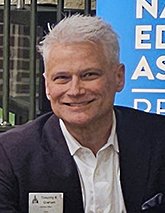
By Timothy R. Graham
KNEA Director of Government Affairs
The issue of a cell phone ban still has me animated.
If I’m being honest, my agitation started before I ever read a line of bill text. We found out about the proposal through the media. No heads up. No courtesy call. No “hey Tim, this is coming.”
Nothing.

And if you recall, in the very first Graham’s Grumblings, I wrote: “After all these years, it’s pretty darn easy for me to recognize what’s going on. Educators are being used as props once again in a hot political battle, and neither side bothered to pick up the phone and call the association that represents more than 20,000 Kansas educators before forming their opinions.”
You could say my reaction was ego-based. It wasn’t.
What I saw wasn’t a bruised ego - it was a bright red warning light.
When even your allies are keeping you at arm’s length, you don’t pout. You ask why.
As your Director of Government Relations, it would be malpractice if I didn’t take a hard look at why we were left out. We need to be at the table on this issue — not reading about it after positions have hardened and talking points have been printed.
At our annual Advocacy Retreat, I told many of you my greatest concern: Even our allies were starting to leave us in the dark because we’ve become too inflexible in our approach. When “hell no” is the starting position on nearly everything, and “local control” is the default response in every debate, over time that takes a toll on your reception in the Statehouse.
That reality has driven my recommendations as we’ve maneuvered through this issue.
And let me be clear: This issue is not going away. We might kill a bill this year. But as long as many districts don’t have meaningful policies in place, this conversation will return. Again, and again.
In my professional opinion, we are far better off dealing with this issue now - while we still have a governor on the second floor of the Kansas Statehouse who understands public education and approaches these questions through the lens of student and educator health. Kicking the can down the road does not make it disappear. It simply changes who will be in the room when it comes back.
Our neutral position on SB 302 - neutral with concerns - demonstrated that we are deliberating in good faith and opened the door to meaningful changes, including the removal of an egregious reporting requirement in the original House bill and the inclusion of liability protection language.
Those are not small things.
Legislators only listen when they believe you’re capable of taking yes for an answer. If we let the perfect be the enemy of the good, we lose influence. Period.
Where this issue goes from here is up in the air. Division within the Republican caucus over whether private schools should be included threatens the passage of anything at all. That may feel like a win to some of our members and allies.
As KNEA’s Director of Government Relations, I can live with that.
As a parent - and as someone who understands how this building works - I’m shaking my head.
Step aside from the maneuvering. The interparty squabbling. The personality clashes. The political theater. All of that is irritating, but it’s also politics. It’s not new, and it’s not going away.
What has me genuinely angry is this: Our children’s mental health - particularly as it relates to screen time and cell phone usage - has taken a back seat to the emotional circus.
Common sense tells us two things.
First, these devices are addictive.
Second, our classrooms are not better places when 20-plus cell phones are vibrating, dinging, lighting up, and pulling attention every few seconds.
And I’m going to say this as plainly as I can: These devices are as addictive as cigarettes, and some of the tech companies that design them are as predatory toward my son’s generation as the tobacco companies were toward mine.
And speaking of tobacco - We’ve had this fight before.
In 2010, Kansas enacted the Indoor Clean Air Act, banning smoking in most indoor public places. Opponents warned of economic disaster. They invoked personal freedom. They invoked local control.
Sound familiar?
Today, no one argues that banning smoking indoors was a mistake.
Now, I’m about to say something that will likely irritate people on both sides of this debate.
But I believe it.
Gov. Laura Kelly is the only politician in this conversation who has consistently placed children’s and educators’ health at the center.
And if you doubt that, look at how she governed during COVID.
During COVID, she was the first governor in the United States to close schools statewide out of concern for the safety of educators and students. That decision was not politically convenient. It was not universally popular. It was not backed by perfect data - because none of us had perfect data in March 2020.
It was backed by caution. By science. By a belief that when you’re dealing with uncertainty and children, you err on the side of safety.
She issued executive orders to provide flexibility to districts so they could transition to remote learning. She worked to ensure schools had access to personal protective equipment (PPE). She supported federal relief efforts that stabilized school budgets and kept educators employed. She publicly defended teachers when rhetoric turned ugly. She made it clear - repeatedly - that protecting educators was not secondary to protecting students. It was intertwined.
When local leaders hesitated, she proposed statewide mitigation efforts, including mask requirements, because she understood something important: “Local control” only works when local leaders are willing to act.
She endured relentless political attacks. Some of the loudest critics were the very people who, behind closed doors, were urging bold action to protect their communities.
And she did all of this in her first term. Facing re-election.
She didn’t govern by poll numbers. She governed by what she believed was the safest course for Kansas families and Kansas schools.
Now, she is term limited. Under the Kansas Constitution, she cannot run again. She has nothing to gain politically by stepping into another heated debate about schools.
Some will say that’s exactly why she’s willing to do it - because she doesn’t have to face a tough re-election.
But that’s not who Laura Kelly is.
As someone who worked as Gov. Kelly’s Director of Government Affairs during her first term, I can tell you this firsthand: She has never governed by popularity polls. She never asked, “Is this good politics?” before asking, “Is this the right thing to do?”
And here’s the interesting part - despite that, she has remained one of the most popular political leaders in Kansas. I know that for a fact. I’ve seen the polling.
She has never chased public opinion. If anything, public opinion has followed her when she was willing to take difficult stands.
And on this issue, she’s doing what she’s always done - putting what she believes is the health and safety of Kansas kids ahead of the politics of the moment.
You can disagree with her approach. You can debate the policy. That’s fair.
But you cannot say she hasn’t been consistent.
As a parent, I’ll say this plainly: Thank you, Gov. Kelly, for being willing to take the heat for what you believe is right.
Politics will continue. The theater will continue. The talking points will continue.
But our kids deserve adults who are willing to put their health - mental and physical - ahead of the noise.
I’ll stay animated on this one.
Timothy R. Graham is the Director of Governmental Relations and Legislative Affairs for KNEA. He has spent more than 25 years working inside Kansas politics and government, including Director of Government Affairs for Gov. Laura Kelly; Deputy Executive Director of the Kansas Lottery; Interim Executive Director of InterHab; Chief of Staff to the Kansas Senate Minority Leader; and Assistant Secretary of State for the State of Kansas. He can be reached via email at timothy.graham@knea.org.
The opinions expressed herein are those of the author alone and should not be interpreted as reflecting the official policies or positions of the Kansas National Education Association (KNEA), its local affiliates, or its members.